Updated: July 2026
The Ultimate Southern Baliem Valley Trekking Route Guide
- Starting Point: Sogokmo, a 45-minute drive from Wamena.
- Key Villages: Kurima, Kilise, Ibiroma, and Userem.
- Primary Experience: Crossing suspension bridges and staying in traditional Dani villages.
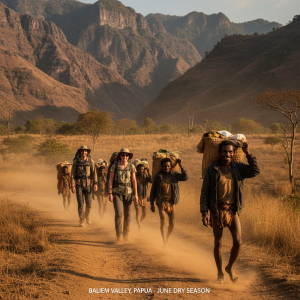
The air in the highlands carries the scent of damp earth and the sweet smoke from a thousand cooking fires. You stand on the edge of Sogokmo, the unofficial trailhead, where the paved world dissolves into a well-trodden footpath. The Baliem River, a formidable ribbon of churning brown water, rushes below, its roar a constant companion. This is not a journey you observe; it is one you feel in the soles of your boots, in the cool 18-degree Celsius air on your skin, and in the quiet, appraising gazes of the Dani people you are about to meet. The path ahead winds through sweet potato gardens and disappears into the dense green, a physical line into one of the planet’s last truly intact indigenous cultures.
Charting the Course: From Wamena to the Southern Loop
Your journey into the southern valley begins not on the trail, but in the bustling, frontier-town atmosphere of Wamena. This is the logistical heart of any expedition into the highlands. Before a single step is taken, all foreign visitors must secure a surat jalan, or travel permit, from the central police station (Polres Jayawijaya). My contact in Wamena, a seasoned guide named Petrus who has been leading expeditions since 1998, advises allocating at least two hours for this process. The fee is nominal, around 150,000 IDR, but the paperwork is non-negotiable. From Wamena, the starting point for the classic southern baliem valley trekking route, Sogokmo, is a 45-minute drive south. The road is rough, a testament to the challenges of building infrastructure in this remote region. This initial drive is an experience in itself, transitioning from the relative modernity of Wamena to a landscape dotted with the circular, thatch-roofed huts known as honai. It is critical to engage a reputable guide and porter team here. Expect to pay a daily rate of around 800,000 IDR for a guide and 500,000 IDR for a porter; this investment is not merely for navigation but for cultural translation, access, and safety. They are the bridge between your world and the intricate social fabric of the Dani.
Day One: Sogokmo to Kilise – The Gateway to Dani Culture
The first day’s trek from Sogokmo to the village of Kilise is an excellent introduction to the valley’s topography and rhythm. Covering approximately 9 kilometers, the walk takes a comfortable four to five hours, including stops. The trail begins with a gentle descent towards the roaring Baliem River, where you encounter your first jembatan gantung. These suspension bridges, often constructed from little more than wood planks and steel cable, are engineering marvels of local ingenuity. Crossing the first one, swaying gently 20 meters above the rapids, is a rite of passage. The path then follows the river before ascending into the hills. You pass through several small hamlets and neat gardens where the Dani cultivate their primary staple, the sweet potato, or hipere. The trail is shared with local villagers, women carrying immense loads in their noken (woven net bags) and men returning from their gardens. The village of Kilise, perched on a hillside at an elevation of roughly 1,800 meters, offers a commanding view of the valley. Accommodation here is basic, typically in a designated guesthouse—a simple wooden building with a few rooms. It provides a genuine opportunity to witness daily life, from the preparation of the evening meal to the sounds of children playing as the highland mist rolls in.
The Heart of the Highlands: Kilise to Ibiroma
The second day is often the most rewarding, a deeper immersion into the cultural landscape. The trek from Kilise to Ibiroma is shorter, perhaps only 3 hours of walking, but it is rich with interaction. This leg of the journey takes you further away from the river, up into the higher slopes. The air thins slightly, and the views become more expansive. Here, you will encounter older Dani men who may still wear the traditional koteka (penis gourd), a sight that has become less common over the last two decades. As our guide, Petrus, explained, “The church and the government encouraged clothes, but the old ways are still respected here, away from the main town.” This is the core of the experience offered by the Bali Em Valley: witnessing a culture in transition. In Ibiroma, we were fortunate to be invited into the village chief’s compound. The social structure revolves around these family compounds, which include the men’s honai, the women’s eweai (oblong family huts), and a communal cooking pit. The economy is visibly centered on pigs, which represent wealth, status, and are central to all ceremonies. Learning about their value—a large pig can be worth upwards of 25 million IDR—provides a profound insight into a non-cash-based society. This is the kind of authentic encounter that defines a well-planned Papua highland trekking adventure.
Engineering and Ecology: Crossing the Baliem River
The physical geography of the southern Baliem Valley is dominated by the river that carved it. A trek here is defined by its crossings. While the first bridge out of Sogokmo is an introduction, the bridge near Userem is the main event. It is one of the longest and highest on this circuit, spanning over 70 meters. Crossing it is a pure dose of adrenaline. The wooden slats are uneven, and the entire structure sways with each footstep, demanding your full attention. According to the Baliem Valley’s official Wikipedia entry, the valley itself is about 80 km long and 20 km wide, a massive rift in the Jayawijaya Mountains. This geography creates a unique microclimate and ecosystem. The trails are lined with pandanus trees, wild orchids, and various ferns. The valley floor, sitting at an average of 1,600 meters above sea level, is remarkably fertile. This fertility is what allowed the Dani to develop a sophisticated system of agriculture, with extensive drainage ditches visible from the trail, a system that has sustained a dense population for centuries. The Indonesian government, through its official tourism portal, indonesia.travel, has recognized the unique cultural and natural heritage of the region, promoting it as a prime destination for adventure tourism.
Beyond the Path: Unique Encounters and Responsible Tourism
While this southern loop does not typically include the famous smoked mummy of Jiwika (located in the northern valley), it offers its own unique rewards. The relative isolation of these southern villages means encounters feel less transactional and more genuine. On our trek, we spent an afternoon with a group of men fashioning stone adzes, a tool that, while largely replaced by steel, is still made and understood. This is living history, not a performance. It is a powerful reminder of the importance of responsible travel in the region. The Baliem Valley is on the UNESCO World Heritage Tentative List, a recognition of its outstanding universal value. As visitors, we have a responsibility to ensure our presence is a positive force. This means adhering to a strict “leave no trace” policy, paying fairly for all goods and services, and always asking for permission before taking photographs of individuals. The most impactful way to contribute is by hiring local Dani guides and porters directly, ensuring that tourism revenue directly supports the communities you visit. A well-organized expedition, like those curated for the Baliem Valley, prioritizes these ethical considerations, creating a more meaningful exchange for both the traveler and the host community.
Quick FAQ on the Southern Baliem Valley Trekking Route
What is the best time of year to attempt this trekking route?
The most favorable trekking season is during the drier months, from March to August. During this period, the trails are less muddy and river levels are lower, making crossings safer. Daily rainfall is still possible, as this is a tropical highland climate, but it is typically less intense than during the September to February wet season. Temperatures remain consistent year-round, averaging 20-25°C in the day and dropping to 10-15°C at night.
Do I absolutely need a guide and porters?
Yes, it is practically non-negotiable and highly recommended. The trails are not marked, and a guide is essential for navigation, safety, and, most importantly, cultural interpretation. They facilitate communication with villagers, arrange accommodation, and manage food logistics. Porters carry your main pack, food, and supplies, allowing you to trek with only a small daypack. This not only makes the trek more enjoyable but also provides vital employment for the local community.
What is the accommodation like in the villages?
Accommodations are basic but authentic. Most villages on the southern baliem valley trekking route have a designated wooden guesthouse for trekkers, often called a “tourist honai.” These are simple structures with a few rooms, usually with wooden sleeping platforms. You will need to bring your own sleeping bag and mat. There is no electricity or running water; toilet facilities are typically a simple, private pit latrine outside the main dwelling.
How physically demanding is the southern Baliem Valley trek?
The trek is considered moderate in difficulty. An average day involves 4-6 hours of walking over varied terrain, including steep but short ascents and descents, and crossing suspension bridges. The primary challenge is not the distance, which is rarely more than 12 kilometers per day, but the uneven trail surfaces and the altitude, which hovers around 1,800 meters. A good level of general fitness is required, but you do not need to be an elite athlete.
The southern Baliem Valley route is more than a trek; it is a passage into a different way of being. It challenges your body, but more profoundly, it recalibrates your perspective on community, wealth, and time itself. The raw beauty of the landscape is matched only by the deep resilience and warmth of the Dani people. To truly appreciate this corner of the world, to navigate its complexities with respect and insight, requires expert guidance. For those ready to embark on this extraordinary journey, we recommend exploring the curated expeditions offered by the Baliem Valley Highlands Society, ensuring your adventure is both unforgettable and responsible.